Podcast: Download

Insightful. Independent. Innovative.
Podcast: Download

Reading Time: 4 minutes
The phrase “Keeping up with the Joneses” originated in early 20th century America from Arthur (Pop) Momand’s comic strip titled “Keeping Up With The Joneses,” which first appeared in the New York Globe in 1913. The strip quickly gained popularity, and by September 1915, it was adapted into a cartoon film shown in US cinemas. The ‘Joneses’ in the comic were not based on specific individuals but served as a generic representation of neighbors, with ‘Jones’ being a common surname.
In today’s fast-paced world, appearances can be deceiving. The notion of “keeping up with the Joneses” has become increasingly prevalent, fueled by social media and a culture of instant gratification. But as Dave Ramsey wisely points out, “Very few people who look like they have money actually do.” This phenomenon often leads individuals and families into precarious financial situations. At Intelligent Investing, we believe in organizing financial “junk drawers” to ensure our clients can make informed decisions without the pressure of maintaining appearances.
The rise of social media platforms has created a continuous stream of visible consumption. It’s now easier than ever to see the luxurious cars, sprawling homes, and exotic vacations that friends, family, and influencers indulge in. This constant exposure has led to a significant number of Americans experiencing what psychologists call “money dysmorphia” — a feeling of insecurity regarding their financial well-being, even if they aren’t as financially unstable as they perceive.
Similarly, in today’s 24/7 news cycle, it’s easy to feel overwhelmed by the sheer volume of information we are exposed to daily. News outlets often emphasize sensational stories to attract viewers and boost ratings. This can lead to a skewed perception of reality, where the world seems more dangerous or chaotic than it actually is. At Intelligent Investing, we understand that this constant exposure to negative news can affect not only your mental health but also your financial decisions.
According to a survey by Qualtrics for Intuit Credit Karma, 29% of American adults report feeling this financial insecurity. The psychological disconnect between perception and reality is even more pronounced among younger generations. A LendingTree survey found that 62% of Gen Z Americans feel financial pressure to keep up with their peers, leading 51% to admit to overspending to impress others. Amongst this group, 56% are now in debt due to their attempts to maintain these appearances.
Borrowing money to splurge on luxury items just to impress others can trigger unsustainable lifestyle inflation. Once a budget is stretched to accommodate a new car, a bigger home, or a lavish vacation, sustaining those expenditures becomes increasingly difficult. This is likely why many high-income Americans are struggling financially. A recent Lending Club survey revealed that roughly half of six-figure earners live paycheck to paycheck.
At Intelligent Investing, we emphasize the importance of understanding the true cost of debt and the impact it can have on long-term financial health. Our proprietary financial software, Intelligrations®, helps clients see the bigger picture and make decisions that align with their values and goals, rather than societal pressures.
On his website, Ramsey outlines his definition of financial success: “True wealth is about three things: making an impact through giving, leaving a legacy, and having options for how you live your life.”
At Intelligent Investing, we resonate with this definition. We believe that financial success involves compassion, legacy, integrity, excellence, nimbleness, and truth — core values that guide our approach to wealth management. Being able to donate to charitable causes is a genuine indicator of economic security. In 2022, regular Americans made 64% of all charitable donations in the U.S., reflecting a strong culture of giving.
Leaving a legacy is another significant sign of wealth. A USA Today Blueprint report found that 68% of Gen Z and millennial Americans expect to receive an inheritance, with the average size being $320,000. This transfer of wealth is a testament to the financial planning and foresight of previous generations.
The freedom to choose one’s lifestyle is perhaps the most subjective measure of wealth. The ability to decide where to live, how to spend one’s time, and the flexibility to pursue one’s passions are invaluable aspects of financial success. At Intelligent Investing, we strive to help our clients achieve this level of freedom through personalized financial strategies.
A classic example of someone who pursued the appearance of wealth only to face financial ruin can be found in the biblical story of the Prodigal Son. In this parable, a young man demands his inheritance from his father and promptly leaves home to indulge in a life of extravagance and excess. He spends his wealth on lavish living, attempting to portray an image of affluence and success. However, his reckless spending quickly depletes his fortune, leading to his downfall. Stricken by poverty and regret, he finds himself destitute and humbled, forced to work as a swineherd. Ultimately, he returns to his father’s house, repentant and seeking forgiveness. The story illustrates the perils of prioritizing the appearance of wealth over financial prudence, demonstrating how the pursuit of superficial status can lead to ruin and the eventual realization of what truly matters.
The pursuit of appearing wealthy can lead to financial ruin. Instead, true wealth is about financial security, the ability to give back, leaving a legacy, and enjoying the freedom to live life on your terms. At Intelligent Investing, we help our clients achieve these goals through strategic planning and a focus on what truly matters. Remember, all that glitters is not gold, and real wealth lies in the peace of mind that comes with sound financial management.
Consider joining our clients and making Intelligent Investing your financial accountability partner. Together, we can navigate the uncertainties of election seasons and beyond, ensuring that your investments remain aligned with your long-term objectives.
Reading Time: 4 minutes
Election years often stir up market volatility, especially when candidates present starkly different viewpoints. While historical data can provide some insights, the future remains unpredictable. Election processes have evolved, with mail-in voting and concerns about voting fraud becoming more prominent issues. In fact, there is a thing called Election Stress Disorder, and perhaps you’ve experienced it.
Election Stress Disorder (ESD) refers to the heightened anxiety and stress individuals experience during election seasons. This phenomenon can be triggered by constant exposure to political news, social media debates, and the uncertainty surrounding election outcomes. Symptoms may include irritability, difficulty sleeping, and feelings of helplessness. Managing ESD involves limiting news consumption, and maintaining perspective on the election’s impact on daily life.
It’s crucial to remember that elections, despite generating headlines, should not deter you from adhering to your financial plan. While it’s natural to have concerns about the election’s impact, history suggests it will likely be a nonissue for your portfolio.
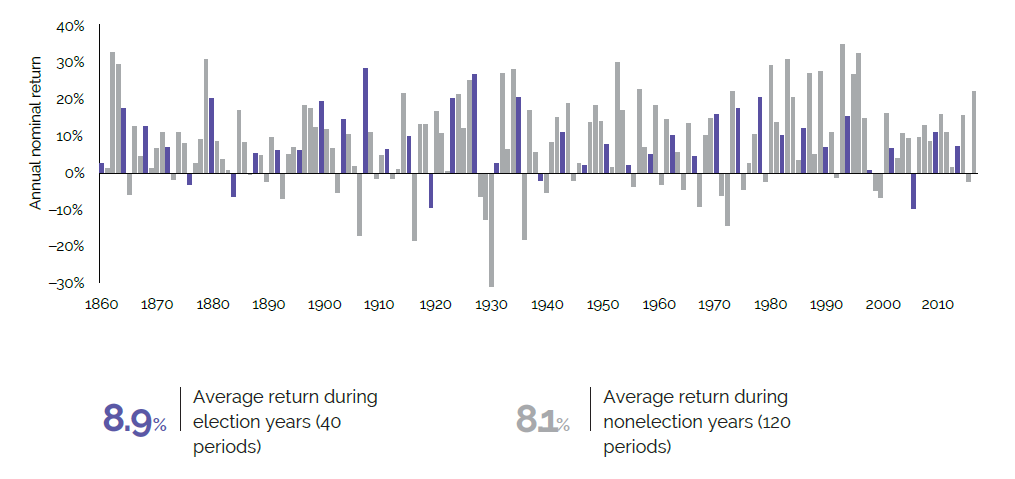
Contrary to what the news might suggest, a wealth of empirical research indicates a different narrative. Vanguard conducted a comprehensive study on stock market performance during presidential election years. One key finding was that market returns do not vary drastically between election and non-election years. Examining data from 1860 to 2010, the average return difference is a mere 0.8%. In addition, Dimensional Fund Advisors has an interactive blog on “How Much Impact Does the President Have On Stocks.”
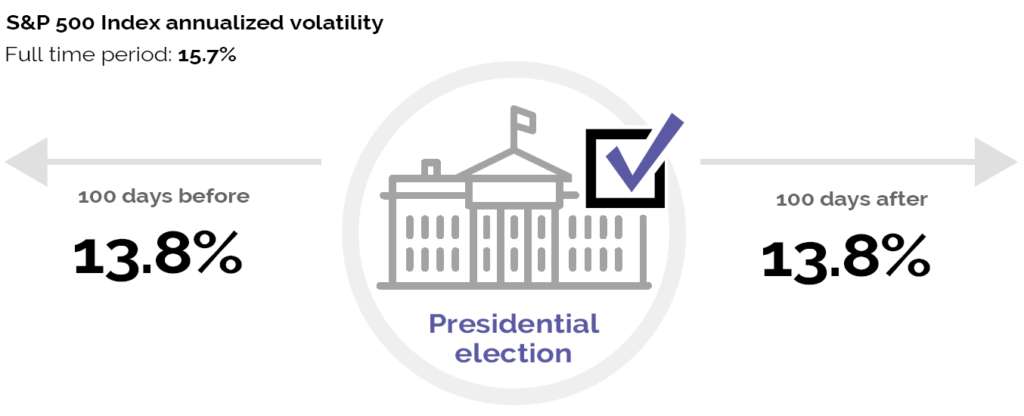
Another common concern is market volatility leading up to an election. Headlines and public sentiment might suggest increased market instability as elections approach. However, data shows otherwise. Analysis of the S&P 500’s volatility 100 days before and after elections reveals that volatility remained consistent at 13.8% in both periods. This demonstrates that markets generally tend to ignore the noise surrounding elections.

At Intelligent Investing, our mission is to minimize financial stress and maximize your life. We act as a buffer between sensational headlines and your portfolio. It’s natural to feel uneasy during election seasons, but it’s crucial to stay grounded and focus on your long-term financial plan.
Successful investing involves focusing on what you can control and keeping emotions secondary to your financial strategy. By maintaining perspective, discipline, and a long-term outlook, you can continue progressing toward your financial goals, despite the short-term uncertainties elections may bring.
The stock market often acts as a leading indicator, beginning to rise before an economic recovery is fully evident. This is one reason why markets can show upward movement even amid negative headlines. Pundits, economists, and other financial advisors will inevitably speculate on election outcomes and other significant events, but our investment philosophy is not based on short-term predictions. We believe in long-term investing, diversification across asset classes, and adherence to risk management principles.
As Leo Tolstoy wisely said, “The two most powerful warriors are patience and time.” Regardless of the election outcome, we appreciate our clients’ trust in us as their financial accountability partner. Our mission is to guide our clients away from emotional extremes, coaching them on adhering to their financial plan, and helping them stay aligned with their long-term goals and risk tolerance.
Consider joining our clients and making Intelligent Investing your financial accountability partner. Together, we can navigate the uncertainties of election seasons and beyond, ensuring that your investments remain aligned with your long-term objectives.
Schedule a short discovery call or meeting
Disclosures:
Returns Graphic: Vanguard calculations, based on data from Global Financial Data as of December 31, 2019. Data represents the 60% GFD US-100 Index and 40% GFD US Bond Index, as calculated by historical data provider Global Financial Data. The GFD US-100 Index includes the top 25 companies from 1825 to 1850, the top 50 companies from 1850 to 1900, and the top 100 companies by capitalization from 1900 to the present. In January of each year, the largest companies in the United States are ranked by capitalization, and the largest companies are chosen to be part of the index for that year. The next year, a new list is created and it is chain-linked to the previous year’s index. The index is capitalization-weighted, and both price and return indices are calculated. The GFD US Bond Index uses the U.S. government bond closest to a 10-year maturity without exceeding 10 years from 1786 until 1941 and the Federal Reserve’s 10-year constant maturity yield beginning in 1941. Each month, changes in the price of the underlying bond are calculated to determine any capital gain or loss. The index assumes a laddered portfolio that pays interest on a monthly basis.
Volatility Graphic: Vanguard calculations of S&P 500 Index daily return volatility from January 1, 1964, through December 31, 2019, based on data from Thomson Reuters. Note: Past performance is no guarantee of future returns. The performance of an index is not an exact representation of any particular investment, as you cannot invest directly in an index.
Notes:
Past performance is no guarantee of future returns. The performance of an index is not an exact representation of any particular investment, as you cannot invest directly in an index. All investing is subject to risk, including possible loss of principal. Be aware that fluctuations in the financial markets and other factors may cause declines in the value of your account. There is no guarantee that any particular asset allocation or mix of funds will meet your investment objectives or provide you with a given level of income. Diversification does not ensure a profit or protect against a loss. Investments in bonds are subject to interest rate, credit, and inflation risk.
Podcast: Download

Reading Time: 2 minutes
At Intelligent Investing Advisors, we often delve into discussions about the intricacies of financial planning, wealth management, and investment strategies. Recently, we had the opportunity to sit down with Rob Isbitts, a seasoned investment expert, to explore the realm of do-it-yourself (DIY) investing.
In our dialogue, Rob drew parallels between DIY investing and everyday tasks like lawn care or tax preparation. While there’s merit in autonomy, he stressed the point where outsourcing to professionals can yield superior outcomes. Recognizing when professional guidance is essential, especially in finance’s complexity, becomes paramount.
Rob illuminated the mindset of the DIY investor, who may view financial advisors as sales-oriented rather than focused on client welfare. While autonomy is admirable, he cautioned against navigating the financial landscape solo. Developing a robust investment philosophy and seeking guidance on non-investment aspects are crucial steps for DIY investors.
Emphasizing the cornerstone of successful investing, Rob highlighted the significance of a well-defined investment philosophy. Articulating beliefs and principles guides decision-making amidst market fluctuations. At Intelligent Investing Advisors, we align with Rob’s stance, emphasizing values and goals alignment in our investment strategies.
Rob stressed the importance of combating behavioral biases in today’s information-rich investment environment. At Intelligent Investing Advisors, we acknowledge behavioral finance’s impact on outcomes and empower clients to make informed decisions grounded in sound financial principles.
As the debate between DIY investing and professional guidance persists, Intelligent Investing Advisors stands firm in empowering clients with knowledge and tools for informed decisions. Whether seasoned or new investors, we offer tailored guidance for each unique financial journey. Let’s navigate the markets together, one informed decision at a time.
Rob Isbitts, the founder of ETFYourself.com, is a seasoned investment expert renowned for his role as a serial myth-buster and educator in the finance industry. With 30 years of professional investment experience, he transitioned from a Wall Street grunt to a fiduciary advisor for nearly three decades. Notably, he sold his advisory practice and “retired” in 2020 at 56, only to enter a “10-year, no-cut contract” to provide model portfolio services. In 2020, he founded Sungarden Investment Publishing, followed by ETFYourself.com in 2023. Rob has authored over 1,000 articles for esteemed platforms like etf.com, Forbes, and Marketwatch, and is a frequent guest on podcasts. He’s recognized as a straight-talker, fair-play advocate, and champion of diversity in investing, with accolades including three-time mutual fund manager, author, and honoree in Worth Magazine’s “Top 100 U.S. Wealth Advisors” list. His wife, Dana Isbitts, plays a pivotal role in managing their ventures.

The Christmas and New Year break brought a delightful family adventure as I took our kids to The Pavilion ice skating rink. Amid the frosty air and laughter, an unexpected turn of events unfolded, weaving an unforgettable tale of resilience and vulnerability.
After an hour and a half of joyful skating, my twin daughters approached, their eyes filled with excitement. They requested their older teen brother’s company, seeking the comfort of holding his hands as they navigated the icy rink. You can guess how that went. Knowing that their older brother would not want to hold their hands, I embraced the opportunity to be my daughters’ hero. I laced up my skates, envisioning a daddy/daughter skate that would etch itself into the fabric of their memories.
However, the canvas of smooth ice turned out to be a bit rough, as the Zamboni had missed re-icing before our skate. Undeterred, we embarked on our adventure.
I should have calculated that the ice was in bad shape after an hour and a half of usage. However, eager to keep pace with the youthful exuberance around me, I took off too quickly, lost my balance, and found myself hurtling forward. In an attempt to regain composure, I leaned too far forward, and the ice skating brakes hurled me forward, resulting in a hard landing on my left shoulder.
Embarrassed and hoping to maintain an air of nonchalance, I rose to my feet. Internally, however, I was grappling with the physical aftermath of the tumble. After concluding our skate with my twins, I headed to the car for a dose of ibuprofen to alleviate the discomfort.
Concerned that I had separated my shoulder, given the audible pop and the peculiar sensation akin to hitting my funny bone, I sought the expertise of my brother-in-law, an orthopedic surgeon based in Anderson. The following day, he worked me into his schedule for a thorough examination and X-rays.
The journey to the examination room was an experience in itself. Clad in a flimsy green gown with darker green crowns, an unconventional take on camouflage, I pondered the parallels between vulnerability in medical situations and our approach at Intelligent Investing.
Just as changing into a gown signifies a willingness to be vulnerable for a medical diagnosis, at Intelligent Investing, we encourage our clients to be open about their financial situations. Our aim is to diagnose and prescribe a financial portfolio that not only supports their financial plan but aligns with their unique goals and dreams.
We delve into the intricacies of our clients’ lives, understanding family dynamics to aid in estate planning and unraveling their fears and investment backgrounds. Sensitivity plays a pivotal role, especially when clients have encountered challenges with past financial advisors.
Just as my brother-in-law needed to see the X-rays to comprehend the full extent of my injury, obtaining a complete picture is crucial in the financial realm. Without a deep understanding of our clients’ goals, family situations, risks, and dreams, we cannot choose or tailor an appropriate portfolio to suit their needs.
Misdiagnosis, whether in a medical or financial context, can lead to suboptimal outcomes. In my case, the accurate diagnosis allowed for the prescription of steroids to alleviate inflammation in my left shoulder, paving the way for a gradual recovery.
Reflecting on the entire experience, I’m grateful for the professionals who, through years of practice, lend their expertise to guide us through various challenges. As we step into 2024, the team at Intelligent Investing aims to be your financial professionals.
Catering to high-net-worth individuals and couples heading towards retirement, we employ our proprietary Intelligrations® to organize financial complexities. Our mission is to minimize financial stress and maximize lives, leveraging our understanding of complex concepts like inflation, taxes, volatility, and investor behavior.
If you resonate with our approach and seek a financial partner to navigate the intricacies of your financial journey, we invite you to reach out. Whether for a call or a coffee, let’s explore how Intelligent Investing, with its proprietary integrations, can be the compass guiding you towards financial success.
For a deeper dive into the parallels between vulnerability in personal experiences and financial interactions, I’ve written a blog post titled Getting Naked. Feel free to explore and gain insights into the essence of our approach at Intelligent Investing.
Podcast: Download
 Reading Time: 3 minutes
In this episode of Intelligent Money Minute, I had the pleasure of interviewing Larry Swedroe, head of Financial and Economic Research at Buckingham Strategic Wealth, on what an intelligent investor should do with market outlooks.
Reading Time: 3 minutes
In this episode of Intelligent Money Minute, I had the pleasure of interviewing Larry Swedroe, head of Financial and Economic Research at Buckingham Strategic Wealth, on what an intelligent investor should do with market outlooks.
Podcast: Download
Reading Time: 2 minutes
In this episode of Intelligent Money Minute, I had the pleasure of interviewing Larry Swedroe, head of Financial and Economic Research at Buckingham Strategic Wealth, on what an intelligent investor should do when an asset class falls out of favor.
Podcast: Download

Reading Time: 2 minutes
In this episode of Intelligent Money Minute, we had the pleasure of interviewing Larry Siegel, the director of the CFA Institute Research Foundation and a prolific investment management author. We dive into a discussion with Larry on the rise of artificial intelligence.
Larry Siegel began by highlighting the dynamic nature of AI technology. It’s a field that’s progressing at a breathtaking pace, making it challenging to keep a steady viewpoint. The implications of AI’s continuous evolution extend far beyond what we can currently anticipate.
An anecdote from Tyler Cowen’s blog, “Marginal Revolution,” left Siegel impressed. The story was written by an AI program and exuded creative writing with a flair for evoking emotions. This starkly contrasted previous AI outputs, which Siegel found unimpressive and likened to amateurish essays.
Despite the breathtaking progress in AI, Siegel remains cautious. While acknowledging AI’s ability to process vast data sets at remarkable speed, he is skeptical about whether it can truly mimic human intelligence. The debate rages on about the extent to which AI can replicate the intricacies of the human brain.
The interview delved into the question of AI’s role in financial advice. Could AI replace human advisors, particularly for intellectual tasks? Siegel’s cautious approach to AI’s evolution is timely given its potential impact on various professional fields, including finance.
At Intelligent Investing, we continuously explore the intersection of technology and human intelligence. As AI develops, it’s essential to strike a balance, recognizing the strengths of both humans and machines. The future will likely demand a collaborative approach to maximize the potential of both.
Laurence B. Siegel is the Gary P. Brinson director of research at the CFA Institute Research Foundation and an author, consultant, and speaker on investment management and economics. Before retiring from full-time work in 2009 he was director of research at the Ford Foundation and, before that, head of research at Ibbotson Associates (since acquired by Morningstar). He attended the University of Chicago (BA 1975, MBA 1977). His book, Fewer, Richer, Greener, has been published by Wiley and is available, along with his other work, at https://www.larrysiegel.org.
