A Question That Arrives Too Late
Over the last decade or so, I’ve noticed a pattern in the questions I get from prospective clients. Someone will ask me about converting part of their traditional IRA to a Roth IRA. It’s a smart question. It’s often the right question.
But by the time I hear it, the person asking has usually already started Social Security. And once that happens, the window for doing much with Roth conversions is already closing, or closed.
Nobody told them the window existed in the first place. That’s not their fault. Nobody had a reason to.
The Switch Nobody Warns You About

Most of the people I work with spent twenty-five or thirty years doing one thing with their 401(k): contributing. Paycheck after paycheck, on autopilot, building a balance through nothing more exotic than discipline and time. They didn’t need an advisor for that. Contributing to a 401(k) isn’t complicated.
Then, somewhere around retirement, the job changes. It stops being about putting money in. It starts being about taking money out — and deciding, all at once, how to coordinate Social Security, Medicare, required withdrawals, and a tax return that suddenly looks nothing like it used to.
I call this the switch. Flipping from accumulation to distribution. And for most people, these are the scary years, because they’ve genuinely never done this before. There’s no twenty-five-year track record to lean on. You get one run at it.
The Years Between Retiring and Claiming
Right in the middle of the switch sits a stretch of time that’s easy to overlook: the years after you retire but before you start Social Security.
Call them the gap years. For some people it’s a year or two. For others, it can stretch out longer, especially if the plan is to delay Social Security to increase the benefit.
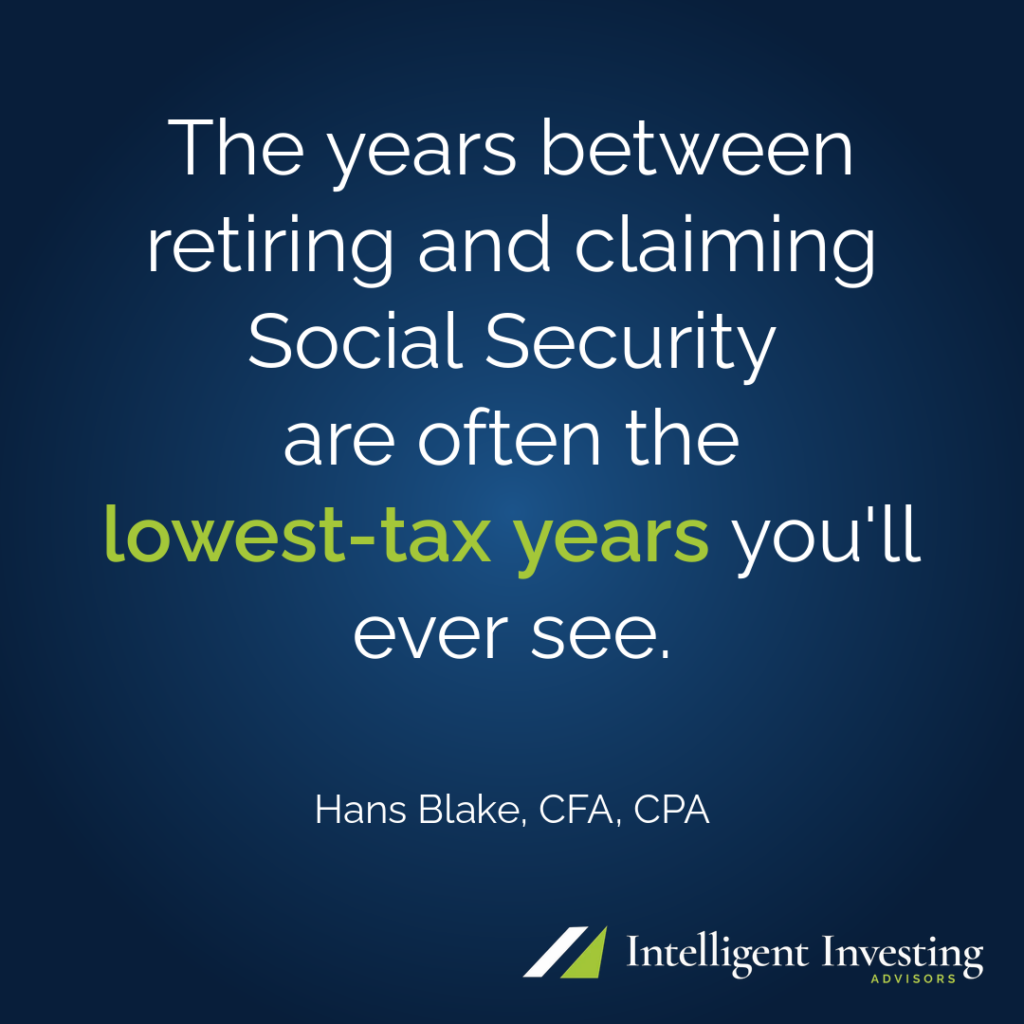
During these years, something interesting happens to a retiree’s taxable income: it often drops. No more W-2 wages. Social Security hasn’t started. Maybe there’s a pension, maybe not. For a window of time, many people find themselves sitting in a lower tax bracket than they’ve occupied in years, and possibly lower than they’ll ever occupy again once Social Security and RMDs are both running.
That’s the opportunity. It’s also the part nobody explains at the retirement party.
What a Roth Conversion Actually Does Here
A Roth conversion, in plain terms, means moving money from a traditional, tax-deferred account into a Roth account and paying the tax on it now, at today’s rate, instead of later, at whatever rate applies then.
Normally that’s a trade-off worth thinking hard about. But in the gap years, with income already lower, that trade-off can look different. The idea is to fill up the current, lower tax bracket — converting enough to use the space in that bracket without spilling over into the next one — rather than leaving that space unused and paying more tax on the same dollars down the road.
This isn’t something to eyeball. It takes coordinating year by year with the client’s CPA: what did they actually earn this year, what deductions apply, where does the next bracket start, how much room is really there. As a client’s advisor, I can sit down with their CPA directly and work through exactly how much conversion makes sense for that specific year — not as a one-time decision, but as something revisited annually while the gap window is open.
Why It’s a One-Shot Decision, Twice Over
Two things happen only once in this story.
The first is Social Security itself. You get one decision about when to start, and once you’ve started, that decision is largely locked in. Claim early and you accept a smaller check for the rest of your life. Wait, and each year of delay increases it. There’s no redo button.
The second is the gap years themselves. Once Social Security starts, that lower-income window generally closes. Add required minimum distributions a few years later — often the point where people are genuinely baffled, since their prior advisor never let them know what an RMD is — and the room to do meaningful Roth conversions shrinks even further.
I understand the instinct to just start Social Security as soon as you’re eligible. There’s something reassuring about locking in income you’ve earned, especially in the first year or two of not having a paycheck. That instinct isn’t wrong. For some people, claiming early is genuinely the right call, depending on health, other income, and what the money is needed for.
But it’s worth knowing what you might be giving up before you decide, rather than after. The value of the gap years doesn’t come from any exotic strategy. It comes from paying attention to a window that’s open for a limited, and often brief, amount of time — and closes whether or not you noticed it.
The Value of These Years
None of this is a guarantee of a better outcome. Tax law changes. Every household’s numbers are different. What makes sense for one couple’s bracket, pension, and Social Security timing won’t automatically make sense for the couple next door. This is general education, not a recommendation for your specific situation — that conversation happens with your own CPA and advisor, looking at your own numbers.
But the pattern is consistent enough that it’s worth pointing out: the years between retirement and Social Security are some of the most valuable, and most overlooked, years in the whole retirement picture. They deserve more attention than a passing thought while you’re also trying to figure out Medicare enrollment and whether the pension has a survivor option.
We love working with couples who are standing right at this point or approaching it — the ones who built something real over three decades perhaps without ever needing help, and now have real questions for the first time. If you’re approaching the switch, or already in the middle of it, it’s worth a conversation before the gap years quietly close.
We are passionate about minimizing financial stress, so you can focus on maximizing your life.